

TL;DR: In 2026, a custom web application typically costs $10,000–$50,000 for a simple MVP or internal tool, $50,000–$150,000 for a mid-complexity product like a customer portal or SaaS v1, and $150,000–$500,000+ for enterprise-grade platforms. The real number depends on scope, integrations, compliance and who builds it. Then budget another 15–25% of the build cost every year to keep it running. This guide shows where the money goes, what AI does (and doesn't) change, and how to get a quote you can trust.
"How much will it cost?" is the first question every founder, product owner and CTO asks us. It's also the question most agencies dodge with "it depends."
It does depend, but not in a mysterious way. After 3,000+ projects since 2008, we've seen the same handful of factors decide almost every budget. Once you understand them, you can read any quote, compare vendors fairly and decide what to cut before a single line of code is written.
Let's break it down.
Why the same app gets quoted at $20,000 and $200,000
Send the same one-paragraph brief to five development companies and you'll often get five quotes that are 10x apart. That's rarely because someone is overcharging. It's because each vendor is quietly filling the gaps in your brief with different assumptions.
"A booking platform" could mean a single calendar with Stripe checkout. Or it could mean multi-location scheduling, staff rostering, SMS reminders, refunds, an admin dashboard and an integration with your existing CRM. Same words, completely different product.
Quotes also differ in what's included:
- Discovery and architecture: some vendors bake it in, others skip it and discover the hard parts mid-build.
- QA and testing: automated test suites, manual QA, performance testing, or "the client tests it."
- Deployment and DevOps: CI/CD pipelines, staging environments, monitoring.
- Post-launch warranty: 30 days of bug fixes, 90 days, or nothing.
The fastest way to narrow the range is to remove the ambiguity. That's exactly what a good requirement elicitation process does.
Custom web application development cost in 2026, by complexity
Most published 2026 estimates converge on three tiers. The ranges below assume a professional team (not a solo freelancer) delivering design, development, QA and deployment.
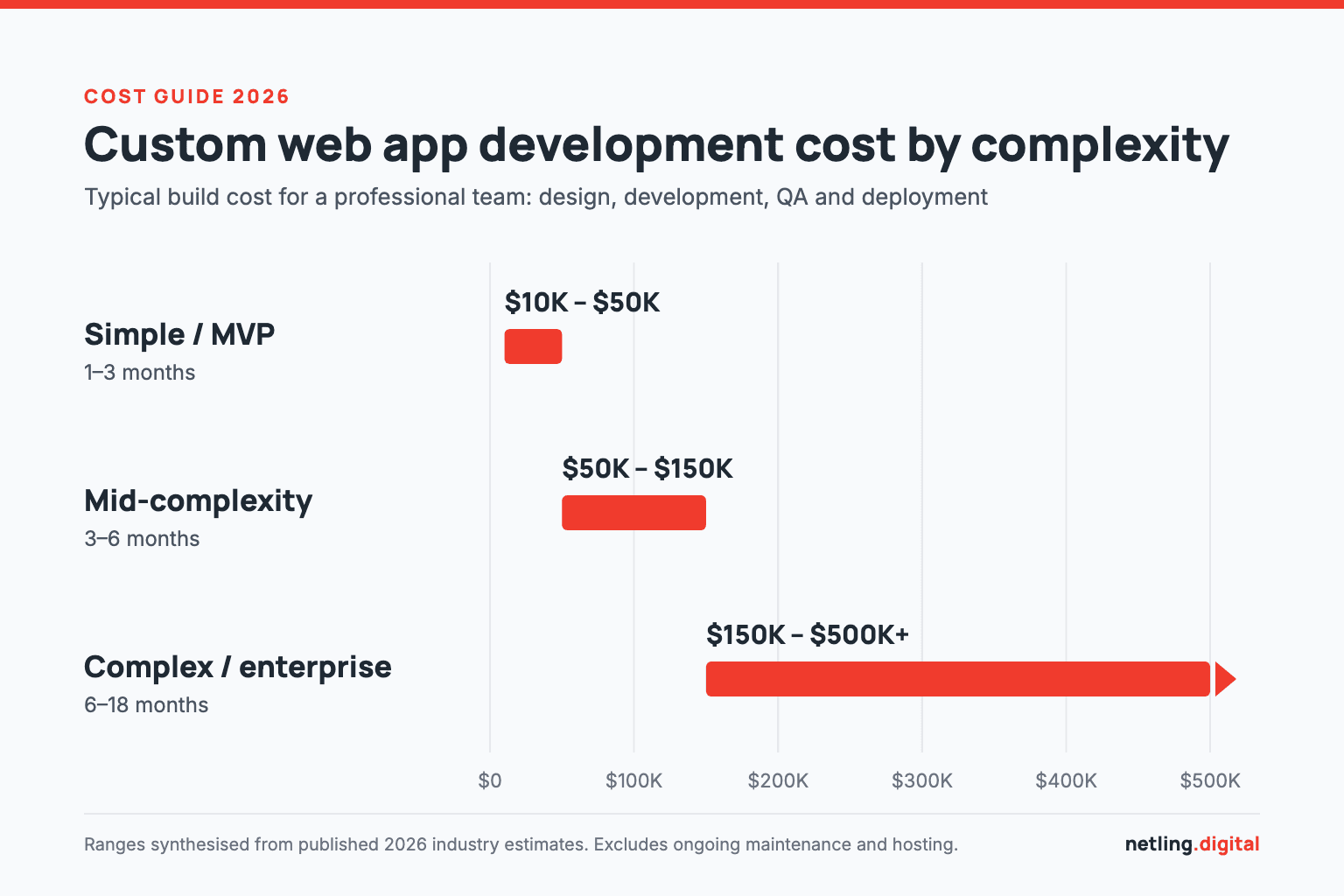
Simple: $10,000–$50,000 (1–3 months)
- MVPs, internal tools, booking or lead-capture apps, simple dashboards
- One or two user roles, roughly 5–15 core screens
- Standard authentication, one payment provider, basic admin
- Off-the-shelf UI component library rather than a custom design system
Mid-complexity: $50,000–$150,000 (3–6 months)
- Customer portals, SaaS products, marketplaces, B2B platforms
- Several user roles with permissions, plus an admin back-office
- Multiple third-party integrations (payments, CRM, email, analytics)
- Custom UI design, reporting, notifications, audit trails
Complex / enterprise: $150,000–$500,000+ (6–18 months)
- Multi-tenant SaaS, ERP-style systems, fintech and healthtech platforms
- Regulatory compliance (GDPR, HIPAA, India's DPDP Act, PCI-DSS)
- Real-time features, heavy data processing, legacy system integration
- High-availability architecture, formal security audits, SLAs
At Netling Digital, a typical MVP ships in 8–12 weeks, which puts most of our startup builds at the upper end of the simple tier or the lower end of mid-complexity.
What actually drives the cost
Features are the obvious cost driver, but they are not the only one. These seven factors decide most of the budget:
- User roles and permissions. Every extra role (customer, vendor, manager, admin) multiplies screens, rules and test cases.
- Integrations. A payment gateway, CRM or ERP connection looks like one line item. In reality it's authentication, webhooks, retries, error handling and the gap between the sandbox and production. Legacy APIs are the most expensive of all.
- Data and migration. Importing years of messy data from spreadsheets or an old system is often a project of its own.
- Real-time features. Live chat, collaborative editing, live dashboards and offline sync need extra infrastructure and far more testing.
- Compliance and security. Encryption, audit logs, data residency, consent flows and penetration testing all add hours, and they're non-negotiable in regulated industries.
- Design ambition. A polished component library is fast. A bespoke design system with custom animations is a significant investment, worth it for consumer products, often unnecessary for internal tools.
- Non-functional requirements. How fast must it be? How many users at once? What uptime? These "invisible" requirements shape the architecture. We've written about why non-functional testing is the backbone of scaling.

Developer rates by region, and why the cheapest hour isn't the cheapest project
Where your team is based still has a big effect on the price. Index.dev's Q2 2026 marketplace data puts senior full-stack developers at roughly:
- United States: $100–150 per hour
- Eastern Europe: $58–85 per hour
- India: $34–52 per hour
Agency rates follow the same pattern. Clutch's 2026 data shows most US and Polish firms billing $50–99 per hour, while Indian and Ukrainian firms cluster at $25–49 per hour.
Here's what that means for a real project. Take a mid-complexity customer portal estimated at 1,000–1,600 engineering hours:
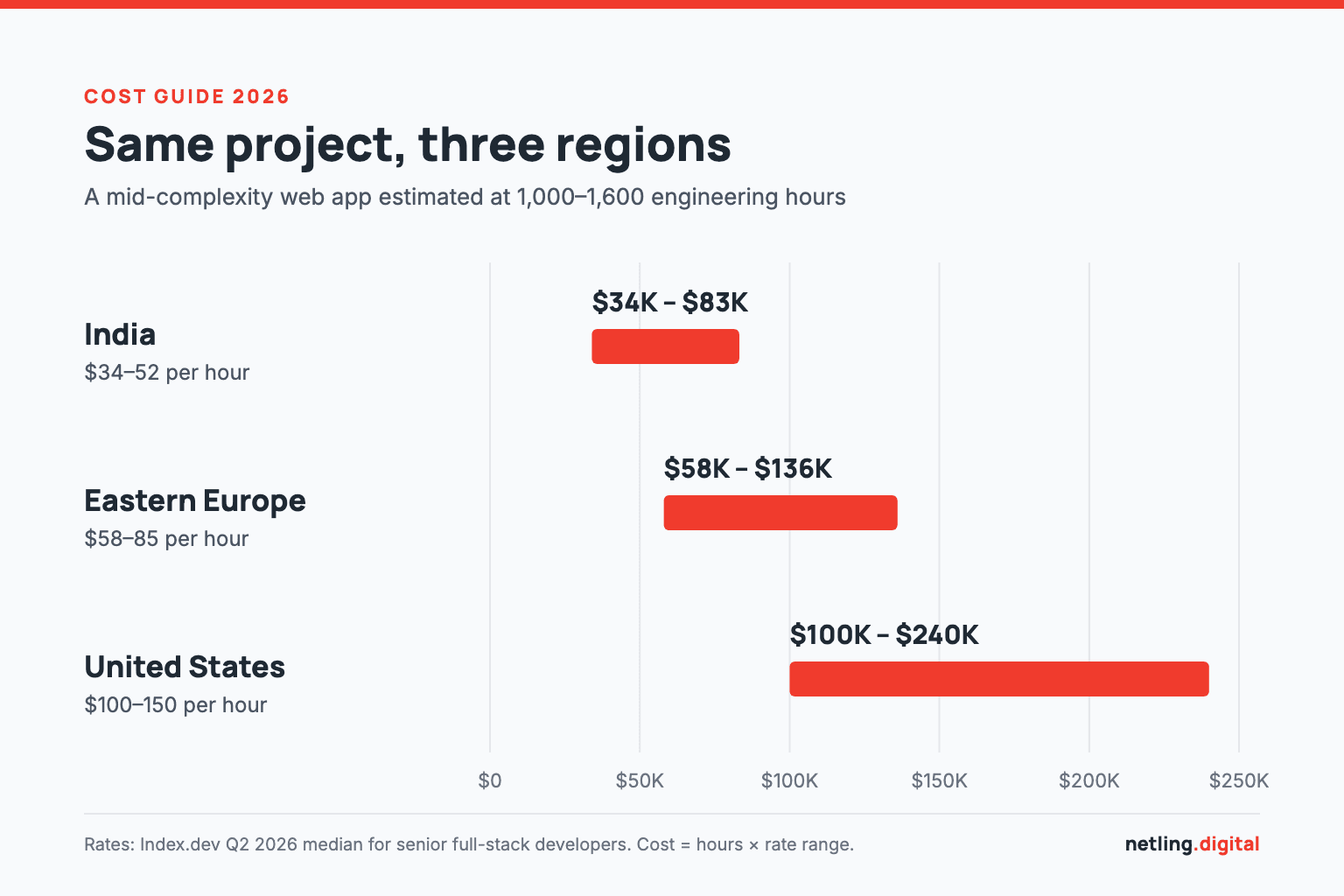
The gap is real. But the hourly rate is only half the equation; the other half is how many hours it takes. A senior engineer who gets the architecture right the first time is far cheaper than a junior team that ships fast and rebuilds twice. Industry analyses also suggest management overhead adds 15–25% on top of headline rates when the vendor doesn't provide strong project management.
So when comparing offshore partners, look past the rate card. Ask who will actually write the code, how seniority is mixed on the team and how they handle code review. Our guide on how to choose a custom software development company covers the questions that matter.
Does AI make custom software cheaper in 2026?
Yes, but not uniformly, and not automatically. The honest answer is more nuanced than most agency marketing suggests.
The research is still mixed. In METR's widely cited 2025 randomised trial, 16 experienced open-source developers took 19% longer to complete tasks when AI tools were allowed, while believing they'd been about 20% faster. When METR re-ran the experiment in 2026, it concluded its new data was no longer a reliable signal, partly because many developers now refuse to work without AI at all. Google's 2025 DORA report found that AI adoption correlates with higher delivery throughput, but also with higher instability: more change failures and more rework.
Our experience matches that picture. AI makes the cheap parts of a project cheaper:
- Scaffolding, boilerplate and CRUD screens
- Test generation and documentation
- Data migration scripts and repetitive refactors
- First drafts of UI from an agreed design
It does very little for the expensive parts: deciding what to build, designing the architecture, handling integration edge cases and reviewing everything before it reaches production. Without strong review and automated testing, AI-generated code can quietly turn today's savings into next year's maintenance bill.
That's why our AI-native workflow pairs AI acceleration with senior engineers who own every architectural decision and review every merge. When a vendor tells you AI cuts your quote, ask two questions: which hours does it remove, and how do you review the code it writes?
The hidden costs: your budget after launch
The build is the down payment, not the total price. Plan for these from day one:
- Maintenance and updates. The common rule of thumb is 15–25% of the original build cost per year. A 2026 benchmark of 24 SaaS products by wavect found median maintenance spend of 24% of build cost in year one, 21% in year two and 26% in year three. Products that are still actively evolving sit at the higher end.
- Hosting and infrastructure. Anywhere from tens of dollars a month for a small internal tool to thousands for a high-traffic platform.
- Third-party services. Email, SMS, maps, authentication, search and AI APIs are usually priced by usage and grow with your user base.
- Security and compliance. Dependency patching, vulnerability scans and periodic audits, especially in regulated industries.
- Contingency. Add a 15–20% buffer to any estimate. Something always comes up.
Using the wavect medians, a $60,000 build costs roughly $102,600 over three years once maintenance is included:
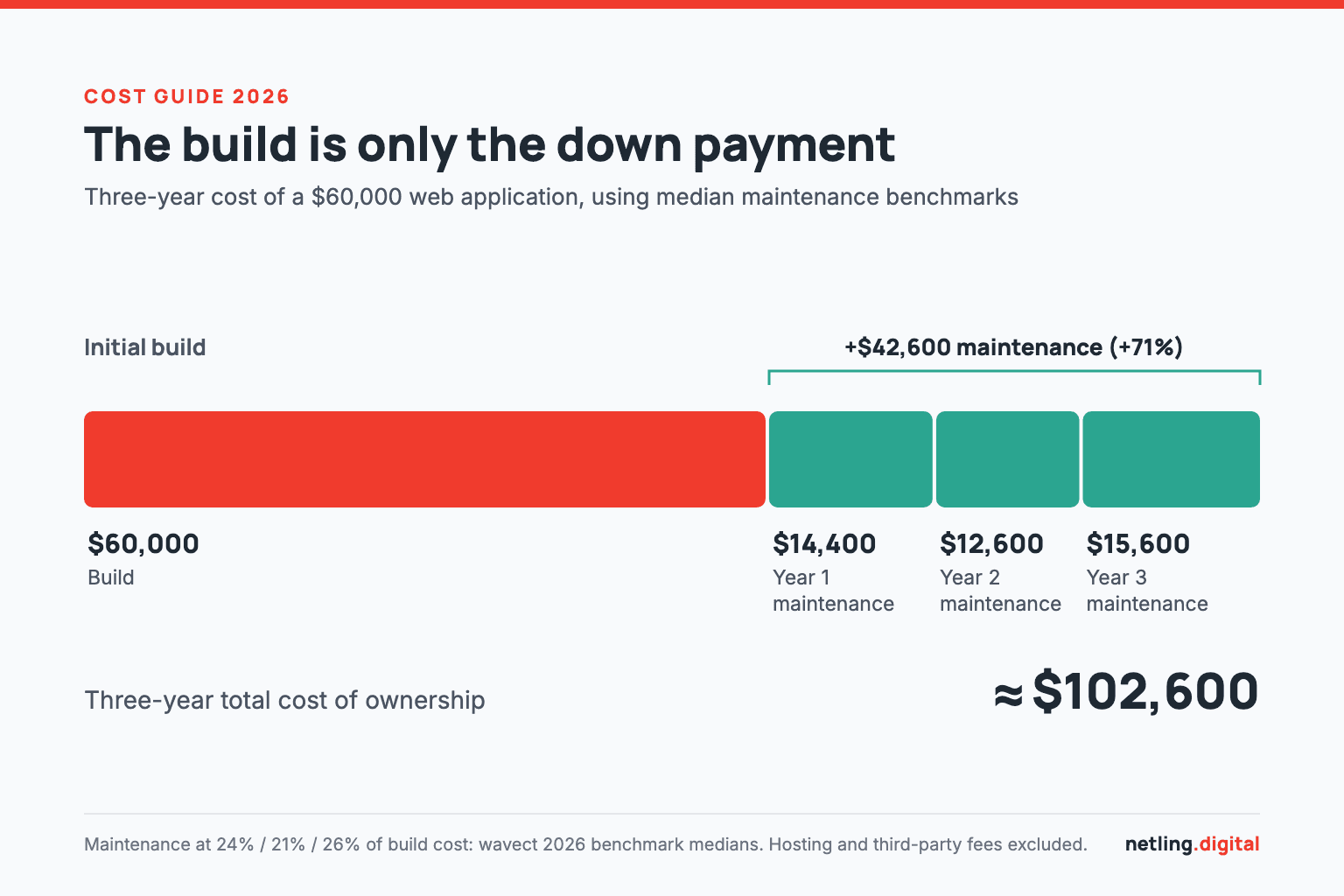
That's why we prefer flat monthly retainers for ongoing maintenance and support: the cost is predictable, and the same team that built your product keeps it healthy.
Fixed price, time and materials, or dedicated team?
How you contract the work changes both the price and the risk:
- Fixed price: best when the scope is small and well-defined, like a tightly specified MVP. You get budget certainty, but expect the vendor to price in risk, and every change becomes a change request.
- Time and materials: best when requirements will evolve, which is most products. You pay for actual hours, keep flexibility and see progress every sprint.
- Dedicated team: best for long-term products with a continuous roadmap. Engineers join your team on a monthly basis, working in your repos and standups.
Many of our clients start with a fixed-price discovery and MVP, then move to time and materials or a dedicated team once the product finds traction.
7 ways to lower the cost without lowering the quality
- Pay for discovery first. A one- or two-week discovery phase is the cheapest insurance you can buy. In our own projects, around 92% of scope changes get caught in discovery rather than during development. See how our process works.
- Cut version one ruthlessly. Use MoSCoW prioritisation to separate must-haves from nice-to-haves. Our complete guide to MVP development walks through it.
- Start with the web. A responsive web app or PWA usually costs less than separate iOS and Android apps. Here's when to build web first and when to go mobile.
- Buy the commodity, build the differentiator. Use proven services for authentication, payments, email and content management. Spend your custom budget on the features that make your product unique.
- Choose boring, hireable technology. Mainstream frameworks are cheaper to build, cheaper to maintain and easier to hire for. Here's the stack we trust.
- Automate testing and deployment from day one. CI/CD and automated tests feel like overhead in month one and pay for themselves by month six.
- Budget for maintenance up front. Products that get regular small updates stay cheap to change. Products left alone for two years need expensive rescues.
How to get an accurate quote
The more of this you share up front, the tighter (and more honest) your quote will be:
- The problem you're solving and who your users are
- The user roles and what each one needs to do
- Your must-have features for launch, and what can wait
- Every system the app must integrate with
- Any existing data that needs migrating
- Compliance requirements for your industry and region
- Your target launch date and a realistic budget range
- Design assets, wireframes or reference products you like
Don't have all of it yet? That's what discovery is for. Start a project brief and we'll help you fill in the gaps.
Frequently asked questions
How much does a simple web app cost in 2026?
A simple custom web app, such as an MVP or an internal tool with one or two user roles, typically costs $10,000–$50,000 and takes one to three months to build with a professional team.
How long does it take to build a custom web application?
Simple apps take one to three months, mid-complexity products three to six months, and enterprise platforms six to eighteen months. A focused MVP can often launch in 8–12 weeks.
Is it cheaper to build a web app with a team in India?
Usually, yes. Senior developers in India bill roughly a third of US rates. The real savings depend on the team's seniority and engineering process, because rework erases rate advantages quickly.
How much does it cost to maintain a web application?
Plan for 15–25% of the original build cost per year for maintenance, security updates and small improvements, plus hosting and third-party service fees.
Can AI tools build my web app for free?
AI app builders are great for prototypes and validating ideas. Production software that handles real users, payments and data still needs engineering for architecture, security, integrations and testing. AI reduces some of that work, but it doesn't remove it.
Final thoughts
Custom web application development cost isn't a mystery. It's the product of scope, complexity, team and process, plus the years of running the software after launch. The cheapest quote is rarely the cheapest outcome. The right partner is the one who asks the hard questions before quoting, shows you exactly where the hours go and still answers your calls three years later.
Want a realistic estimate for your idea? Book a free consultation or start your project brief. We'll give you a clear scope, timeline and cost with no surprises.
More Articles
Continue reading from our engineering blog.

Complete Guide to MVP Development for Startups 2026
Building an MVP in 2026 isn't just about cutting features; it's about leveraging AI-native workflows and high-level engineering craft to ship products that validate and scale.

Web App vs Mobile App: Which Should You Build First?
Is the "Mobile First" mantra still relevant? We compare web apps vs. native mobile apps across cost, speed, and UX to help founders make the right strategic bet.

From Chaos to Clarity: A Masterclass in Requirement Elicitation for Complex Custom Software
Most software projects don't fail because of bad code; they fail because of misunderstood requirements. This masterclass breaks down the framework for turning chaotic visions into precise technical blueprints.