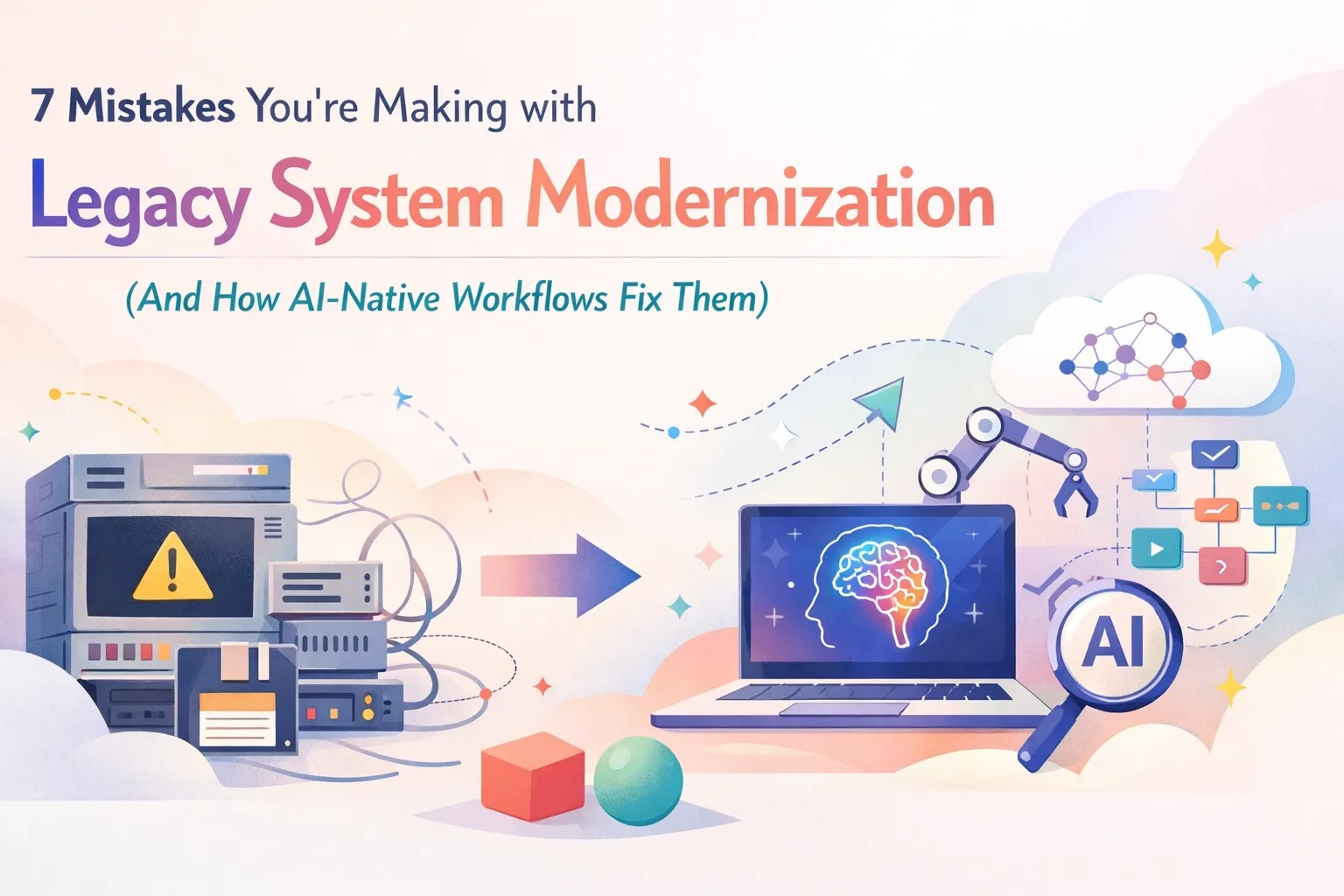
7 Mistakes You’re Making with Legacy System Modernization (And How AI-Native Workflows Fix Them)
TL;DR
Legacy system modernization projects fail when teams rely on manual audits or risky "big-bang" cutovers. As a leading custom software development company, Netling Digital uses AI-native workflows to fix this by running automated discovery across your code and data, then executing incremental shifts so you can ship value fast—with zero surprises.
Legacy system modernization is the ultimate high-stakes surgery for your business. For many CTOs and VPs of Engineering, it feels like trying to replace an aircraft engine while the plane is at 30,000 feet. You know the technical debt is suffocating your growth, but the fear of a botched migration keeps the status quo in place.
Traditional software agencies approach modernization with a "brute force" mindset: hundreds of manual hours, endless documentation cycles, and a high probability of missing the hidden business logic buried in 20-year-old COBOL or Java monoliths.
At Netling Digital, we’ve pioneered a different path. As an AI-native engineering studio, we don’t just throw more developers at the problem. We use AI-integrated workflows to de-risk the process, accelerate delivery, and ensure the new system isn't just a "modern" version of the old mess.
If you’re planning a transition, avoid these seven critical mistakes that sink legacy projects: and see how AI-native engineering changes the game.
1. Treating Discovery as a Manual Audit
The biggest mistake happens before a single line of code is written. Traditional agencies spend months interviewing stakeholders and manually reading old documentation (which is usually out of date). This "manual discovery" is prone to human error and often misses the "shadow logic": those undocumented edge cases that only exist in the code.
The AI-Native Fix: We use Large Language Models (LLMs) and specialized code analysis agents to ingest your entire legacy codebase in hours, not weeks. Our AI-native workflow generates a comprehensive knowledge graph of your system, identifying every dependency, hidden integration point, and redundant module. You get a pixel-perfect map of your technical debt before we even start the migration.
2. The "Big Bang" Migration Trap
Many enterprises attempt a "Big Bang" migration: shutting down the old system and flipping a switch to the new one. This is a recipe for disaster. The complexity of legacy systems, with their 30-year-old nuances, makes a total migration in a single leap nearly impossible to execute without catastrophic downtime.
The AI-Native Fix: We advocate for incremental modernization. By utilizing AI to identify clean boundaries within your monolith, we can help you carve out microservices one by one. Our workflows allow us to generate "strangler pattern" shims: temporary bridges between old and new code: automatically. This ensures you ship value every two weeks rather than waiting two years for a single launch.

3. Ignoring the "Why" Behind the Code (Lost Domain Knowledge)
In legacy systems, the original architects are often long gone. The current team knows what the code does, but they don’t know why it was built that way. When a custom software development company tries to rewrite this without understanding the underlying business intent, they inevitably break critical business rules that were "baked in" over decades.
The AI-Native Fix: AI doesn't just read code; it interprets intent. We use AI-powered reverse engineering to translate legacy code into plain-English business requirements. This allows your current product managers to validate the logic against modern business needs. We close the gap between the technical reality of 2005 and the strategic goals of 2026.
4. Overlooking Data Integrity and Architecture
Data mishandling is a primary cause of modernization failure. Legacy data often contains hidden inconsistencies, overloaded fields (where a "comments" field is actually being used to store a crucial ID), and historical assumptions. Building a modern UI on top of a broken data architecture is like putting a fresh coat of paint on a crumbling foundation.
The AI-Native Fix: We deploy AI-driven data mapping tools that scan your legacy databases for anomalies and patterns. These agents suggest the optimal schema for your new system and automate the ETL (Extract, Transform, Load) process. By the time we move your data, it’s already cleaned, normalized, and optimized for your new AI-ready architecture.
5. Manual Testing Bottlenecks
Modernizing a system requires thousands of regression tests to ensure the new version behaves exactly like the old one (except where intended). Traditional agencies rely on manual testing or writing unit tests from scratch: a process so slow it often becomes the project's primary bottleneck.
The AI-Native Fix: We automate the "un-automatable." Our AI-native workflow generates comprehensive test suites directly from your legacy system’s behavior. By analyzing execution paths, we can create thousands of test cases that verify parity between the old and new systems. This allows us to ship with 100% confidence and zero "hidden" bugs.
6. Misalignment Between Tech and Business Goals
Modernization is often treated as a "technical upgrade" rather than a strategic transformation. If you spend $2M to move from a local server to AWS but your release cycle is still six months long, you haven’t actually modernized: you’ve just changed your hosting bill.
The AI-Native Fix: As a modern custom software development company, Netling Digital focuses on "Engineering Craft." We align every technical move with a business KPI: whether that’s reducing cloud costs, improving user latency, or enabling your team to deploy daily. Our AI-native approach reduces the "overhead" of development, allowing us to spend more time on high-value features that drive your bottom line.
7. Hiring a Traditional Agency Instead of an Engineering Studio
The "old school" agency model is built on billable hours. The longer a project takes, the more they make. Legacy system modernization is their favorite kind of project because it is inherently slow and opaque.
The AI-Native Fix: Netling Digital is an AI-Native Engineering Studio. We prioritize speed and transparency, with proactive communication and structured delivery that keeps you in control: no surprises, no hidden overhead. With 18+ years of experience and 3,000+ projects delivered, we use AI-native workflows to automate the mundane tasks: boilerplate code, documentation, basic refactoring: so our senior engineers can focus on meticulous architecture and complex problem-solving that your enterprise deserves.
The Netling Digital Advantage: AI-Native Modernization
Legacy system modernization doesn't have to be a multi-year slog through the trenches of technical debt. By embracing AI-native workflows, we offer a "High-Craft" approach that traditional agencies simply cannot match.
Why CTOs Choose Us:
- Speed: AI-assisted refactoring allows us to ship 2x faster than traditional manual teams.
- Stability: Automated test generation ensures that "Day 1" of your new system is bug-free.
- Scalability: We don't just fix the past; we build for the future, ensuring your new architecture is "AI-Ready" from the start.

Our Methodology:
- AI-Discovery: Rapid ingestion and mapping of your legacy estate.
- Strategy & Decoupling: Identifying microservices and modular boundaries.
- Bespoke Engineering: Writing clean, modern code using AI-native workflows to ensure quality and speed.
- Continuous Validation: Real-time parity testing between old and new systems.
- Launch & Scale: Seamless cutover with zero surprises.
Modernizing your legacy system is a necessity for survival in an AI-first world. Don't let the mistakes of the past dictate the speed of your future. Whether you are looking to refactor a monolith, migrate to the cloud, or completely rebuild a core business application, we provide the meticulous engineering expertise needed to get it done right.
Ready to move beyond the "Old School" way of building?
Start where you are and modernize with confidence: explore our Modernization, Build, or Scale services to see how Netling Digital delivers digital products faster and smarter with AI-native engineering craft. Let’s transform your legacy into your competitive advantage.

For more information, contact us directly at netling.digital.
More Articles
Continue reading from our engineering blog.
Complete Guide to MVP Development for Startups 2026
Building an MVP in 2026 isn't just about cutting features; it's about leveraging AI-native workflows and high-level engineering craft to ship products that validate and scale.
Web App vs Mobile App: Which Should You Build First?
Is the "Mobile First" mantra still relevant? We compare web apps vs. native mobile apps across cost, speed, and UX to help founders make the right strategic bet.
From Chaos to Clarity: A Masterclass in Requirement Elicitation for Complex Custom Software
Most software projects don't fail because of bad code; they fail because of misunderstood requirements. This masterclass breaks down the framework for turning chaotic visions into precise technical blueprints.