

TL;DR: For a SaaS app started in 2027, the React tech stack we recommend is Next.js, Tailwind 4, shadcn/ui, TanStack Query, React Hook Form with Zod, Vitest and Playwright. The Vue version swaps in Nuxt 4, Nuxt UI, Nuxt's data composables and Pinia. We shipped shadcn/ui, React Hook Form and Zod on 2026 client projects. Budget a monthly patch slot either way: GitHub lists 51 security advisories for Next.js so far in 2026 and 25 for Nuxt.
Before your new app's first commit, you pick a library for each frontend layer. Three groups then maintain them: your developers, the contractor you add when the roadmap fills up, and the AI assistant each of them codes with. Whatever is in the repo first becomes the example a new developer and an assistant read, so your first picks shape what everyone writes later.
This guide is for the CTO or lead developer of a small SaaS team starting a web app in 2027. It was prompted by Yangshun Tay's "My recommendations for libraries in the frontend", which picks one library per layer for React only. We add a Vue pick per layer and differ from him in four places: the store, data fetching, the meta-framework, and lint and format.
Disclosure: we sell React and Vue development, so the sections below say when a pick is the wrong one.
What is a React tech stack? 14 layers, the same for Vue
A React tech stack is the set of libraries and tools that build, test and ship a React app's interface. A Vue app's frontend tech stack has the same layers, with different picks in some of them.
The sheet below lists 14 layers in the order this guide covers them. TypeScript is assumed in both columns, so it isn't a row.
React tech stack at a glance: 14 layers, with the Vue pick for each
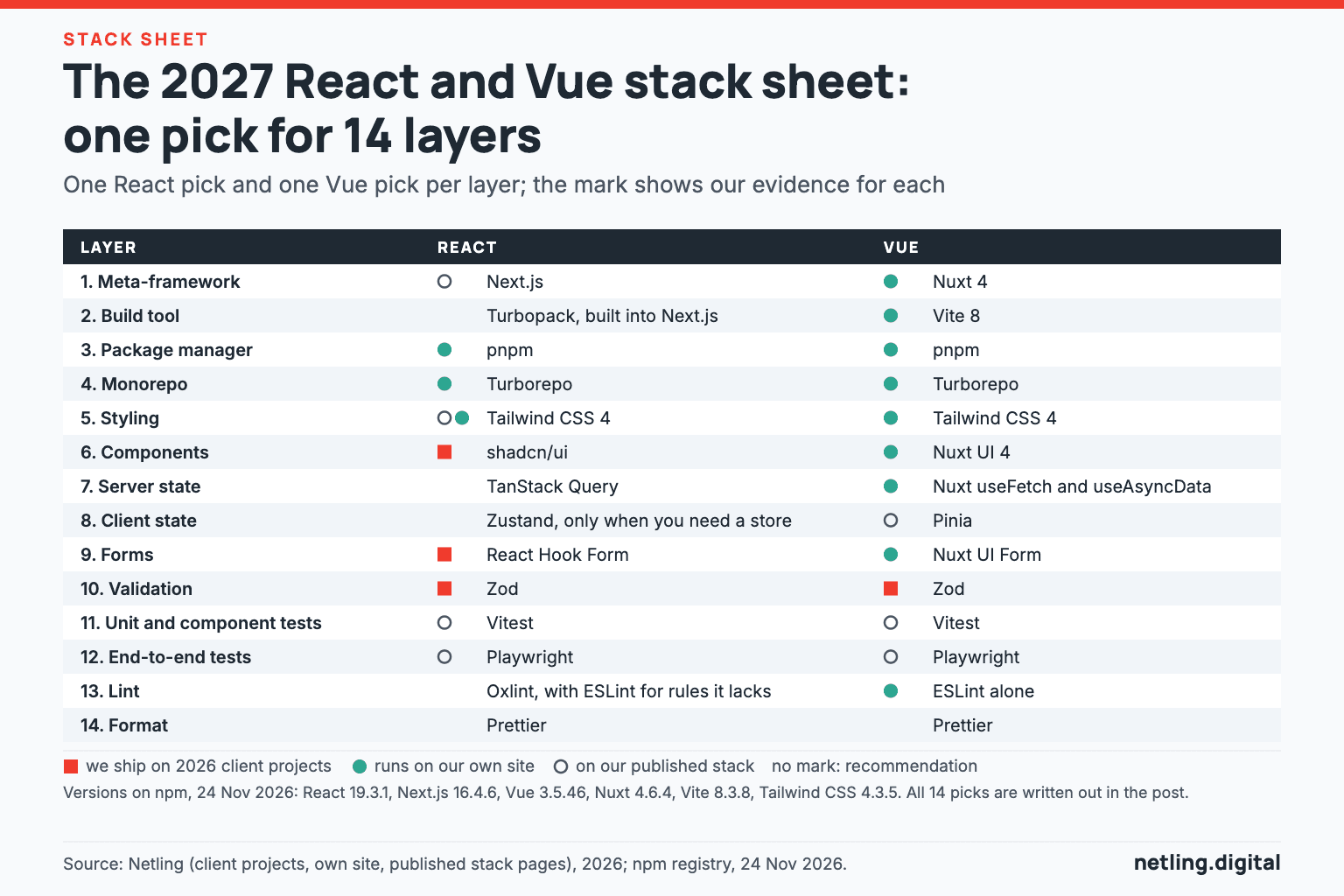
The brackets show our evidence. "We ship" means it shipped on our 2026 client projects, and "our own site" means netling.digital runs it. "Our stack page" means a live Netling page (Build, technology stack or a hire page) lists it. Unlabelled picks are recommendations.
- Meta-framework: Next.js (our stack page) · Nuxt 4 (our own site)
- Build tool: Turbopack, built into Next.js · Vite 8 (our own site)
- Package manager: pnpm (our own site) · pnpm (our own site)
- Monorepo: Turborepo (our own site) · Turborepo (our own site)
- Styling: Tailwind CSS 4 (our stack page, our own site) · Tailwind CSS 4 (our own site)
- Components: shadcn/ui (we ship) · Nuxt UI 4 (our own site)
- Server state: TanStack Query · Nuxt
useFetchanduseAsyncData(our own site) - Client state: Zustand, only when you need a store · Pinia (our stack page)
- Forms: React Hook Form (we ship) · Nuxt UI Form (our own site)
- Validation: Zod (we ship) · Zod (we ship)
- Unit and component tests: Vitest (our stack page) · Vitest (our stack page)
- End-to-end tests: Playwright (our stack page) · Playwright (our stack page)
- Lint: Oxlint, with ESLint for rules it lacks (Oxc's recommendation, untested by us) · ESLint alone (our own site)
- Format: Prettier · Prettier
Versions on npm on 24 November 2026: React 19.3.1, Next.js 16.4.6, Vue 3.5.46, Nuxt 4.7.0, Vite 8.3.8 and Tailwind CSS 4.3.5.
Keep every default unless the bold exception in its layer's section describes your app. The sheet leaves out i18n and animation, because the right library for each depends on the product.
How we chose a modern frontend stack three groups can maintain
Every pick had to pass four tests:
- Stable: version 1.0 or later, so the API a contractor learns doesn't move under them.
- Hireable: a developer pool you can fill seats from.
- Patchable: a security load your team can absorb.
- Written down: conventions in official docs, so a contractor and an assistant follow the same pattern.
Yangshun picks React partly because, he argues, AI agents know it best. We haven't measured that, so it decides no row here. Test 4 covers assistants instead, and writing conventions down before any code is how you pass it.
React or Vue: pick the one your team already ships
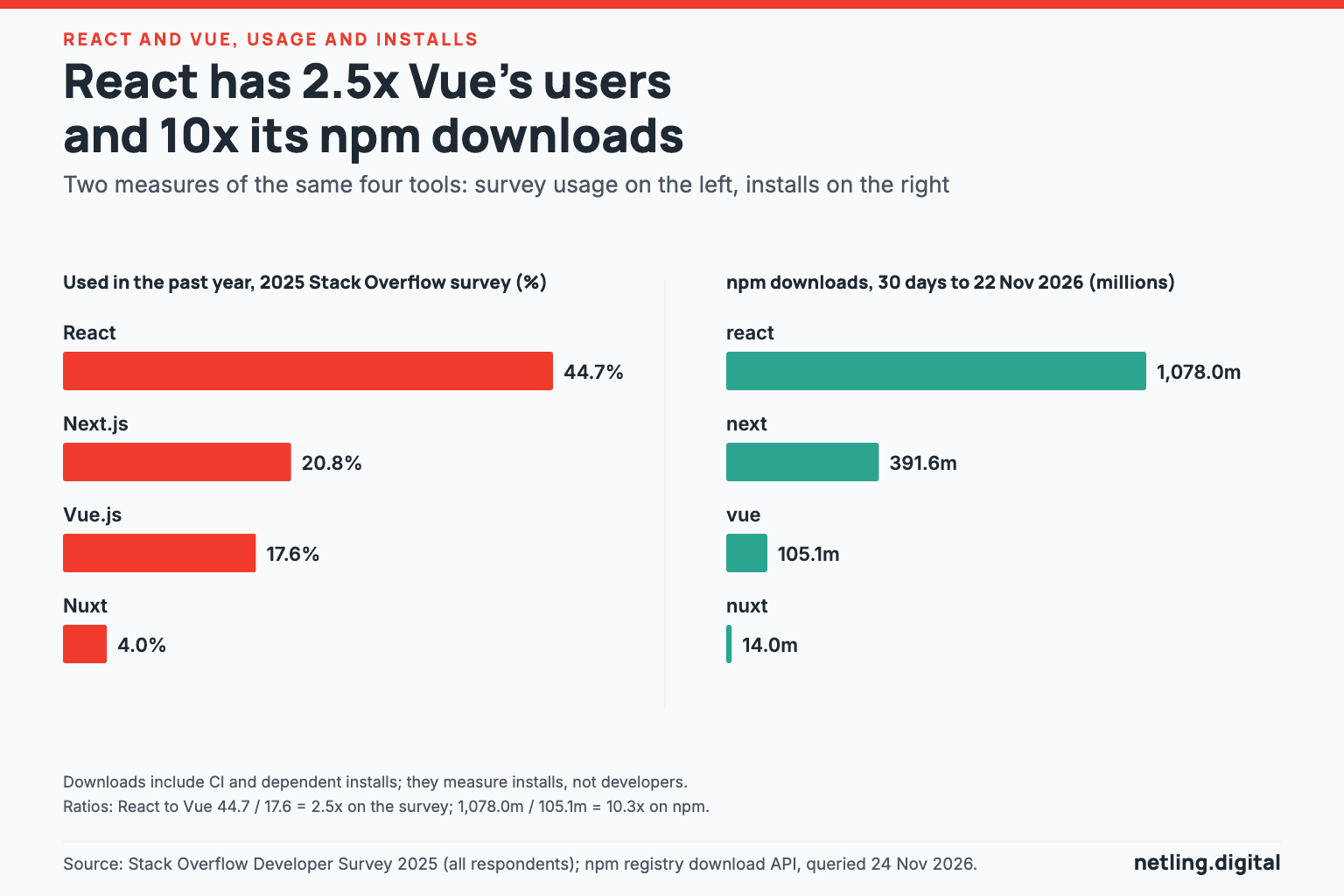
In the 2025 Stack Overflow Developer Survey, 44.7% of respondents had used React in the past year and 17.6% Vue, about 2.5 to 1. On npm, react had 1,078m downloads in the 30 days to 22 November 2026 against 105.1m for vue, about 10 to 1. Downloads count CI runs and installs pulled in by other packages, not developers.
If your team already ships in one, keep it; if you are hiring the whole team from scratch, React gives you the larger pool. Vue 2 reached end of life on 31 December 2023, so a new Vue app is a Vue 3 app.
Meta-framework: Next.js for React, Nuxt 4 for Vue
Next.js, with about twice Nuxt's security advisories in 2026
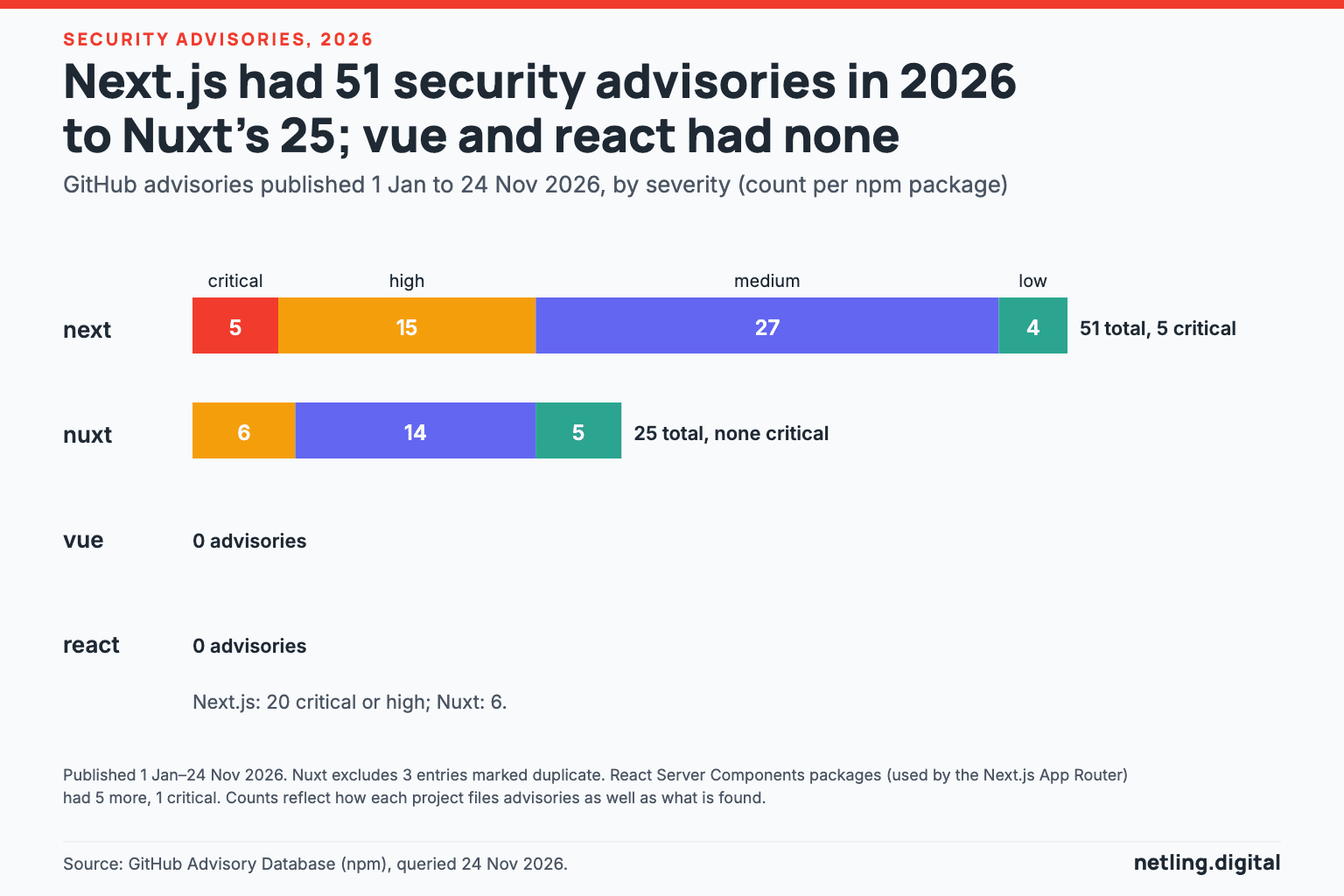
Next.js is on our published stack, and its cost is upkeep. The GitHub Advisory Database lists 51 advisories for next published between 1 January and 24 November 2026, 5 critical and 15 high. Nuxt had 25, none critical and 6 high. The React Server Components packages the App Router uses had 5 more in the same window, 1 critical. That came on top of CVE-2025-55182, a CVSS 10.0 remote code execution flaw disclosed in December 2025.
Counts reflect how each project files advisories as well as how many flaws exist. So compare severity too: 20 critical or high for Next.js against 6 for Nuxt. Whichever you pick, put a patch slot in every month's plan and stay on a supported minor version. On Next.js, expect to use it. These are public counts, so check your own dependency tree too.
Yangshun accepts any of four (Void, Next.js, React Router or TanStack Start) because they are converging. We name one, because a contractor joining mid-project learns one framework's routing and data rules.
When to skip Next.js: Vite, TanStack Start or React Router
Choose differently when the app is a dashboard behind a login with no SEO needs: a plain React app on Vite is enough. That is also how our React and Next.js developers choose.
If you want routing and server functions without React Server Components, TanStack Start has been stable at 1.0 since 13 October 2026. If your team already knows Remix, start on React Router's framework mode, which the Remix team recommends for new projects.
Nuxt 4 for the Vue tech stack, and why not to wait for Nuxt 5
Nuxt 4 runs our own site. Nuxt 3 reached end of life on 31 July 2026 and no longer gets security patches.
Start on Nuxt 4. The Nuxt roadmap pencils in Nuxt 5, with Nitro v3, for Q4 2026 (estimated). But npm had no 5.x release on 24 November 2026, and Nuxt 4 stays supported for six months after 5 ships. Vue 3.6 with Vapor Mode is still a release candidate (rc.16, published 20 November 2026), so don't start a production app on it.
Choose differently when the app is a single-page app behind a login: plain Vue 3 with Vite and Vue Router is enough.
Build tool and repo: Vite 8 (Turbopack inside Next.js), pnpm and Turborepo
Vite 8 is the build tool for a new Vue app and for any new React app outside Next.js. Vite 8 shipped on 12 March 2026 with Rolldown as its single Rust bundler. Linear reported its production build falling from 46 s to 6 s. It needs Node 20.19+ or 22.12+, so check your CI image before you upgrade. Our own site builds on Vite 8 through Nuxt 4.6.
Inside Next.js, the pick is Turbopack: Next.js 16 made it the default bundler for all apps. Keep Webpack only when your Next.js app depends on a custom Webpack set-up: build with next build --webpack until you move it over.
Vite+ 1.0 (28 September 2026) wraps create, dev, check, test and build in one vp command. It isn't on the sheet, because by default vp check runs Oxlint without ESLint, and Oxfmt instead of Prettier. On a copy of our app it ignored our ESLint config, and Oxfmt's defaults flagged all 119 files against our code style.
pnpm and Turborepo cover both columns, and both run our own site. Keep npm or Yarn when your CI and hosting are already set up for it, and skip the monorepo tool when it is a single app.
Styling and components: Tailwind 4, with headless primitives underneath
Tailwind CSS 4 is the pick for both columns, as it is for Yangshun, and it runs our own site. Version 4 moved configuration into CSS, and Tailwind's own benchmark has its full builds 3.78x faster than version 3. Choose CSS Modules or Sass when you carry an existing Sass codebase across, because moving to Tailwind means rewriting every component's styles.
For React components, shadcn/ui's docs say it plainly: "This is not a component library. It is how you build your component library." You copy its components into your repo and own the code. We ship shadcn/ui on 2026 client projects. Underneath, use headless primitives such as Base UI (stable 1.0 since December 2025) or Radix.
For Vue, Nuxt UI 4 runs our own site. It is built on Reka UI and Tailwind, and works in plain Vue apps as well as Nuxt.
Base UI and Reka UI handle ARIA attributes, keyboard navigation and focus management. Accessible labels, visible focus styles and colour contrast stay your job. Choose differently when a designer owns a full design system: build your own components on the same primitives.
State, data and forms: where we disagree with Redux
In an app whose data comes from an API, put that data in a server-state cache first, then see what is left for a store.
Server state: TanStack Query, or Nuxt's own composables
For React, we recommend TanStack Query, with 355.1m npm downloads in the 30 days to 22 November 2026. Yangshun picks fate, "a modern data client for the web inspired by Relay and GraphQL".
But fate's repo dates from October 2025, and react-fate had 13,502 downloads in the same 30 days. For a codebase that changes hands, we stay with TanStack Query. Choose fate when your team wants Relay's normalised cache without GraphQL and will keep the code in-house.
In Nuxt, useFetch and useAsyncData do this job, and they run our own site. In a plain Vite app, use TanStack Query for Vue (4.8m downloads).
Client state: Zustand only when you need a store, Pinia for Vue
Yangshun picks Redux. We'd start with no store and add Zustand when the app needs one. In the same 30 days, zustand had 384.3m downloads against 204.0m for Redux Toolkit, about 1.9 times as many.
For Vue, the Vue docs say: "It is recommended to use Pinia for new applications." Pinia is in the toolkit on our Nuxt developers page. Our own site needs no store and has none installed.
Put state someone might share or bookmark, such as filters, tabs and pagination, in the URL.
Choose Redux Toolkit when several teams edit the same complex client state and want Redux DevTools' action log.
Forms and validation: one schema for the form and the API
For React forms, we pick React Hook Form (263.8m downloads). For Vue, Nuxt UI's Form accepts any Standard Schema library, such as Zod, Valibot or Yup, and ships with none. For validation in both columns, Zod.
We ship React Hook Form and Zod on 2026 client projects. The reason to pair them: one Zod schema validates the form in the browser and the input on the server, so the checks can't drift.
Choose another Standard Schema library, such as Valibot, when your API already defines its schemas in one, and validate the form with that same library.
Our own site's four forms (contact, briefings, careers and article import) use Nuxt UI's Form with hand-written checks and no schema library. That works while each field is checked in one place; once the same fields are checked in two, we recommend a schema.
Choose VeeValidate (6.3m downloads) with the same Zod schema when you use Vue without Nuxt UI.

Testing: Vitest and Playwright, and Storybook only with a design system
Vitest handles unit and component tests (759.7m downloads in 30 days) and Playwright end-to-end tests; both are on our full technology stack. Cypress is on that page too.
But Playwright runs test files in parallel by default across Chromium, Firefox and WebKit. Cypress supports WebKit only as experimental, and its parallel runs need the --record flag and Cypress Cloud. On npm, @playwright/test had 513.9m downloads against 31.4m for cypress.
Storybook adds a tool and its own conventions for the team to learn. Add Storybook when a design system serves more than one app, and skip it otherwise.
Choose differently when your team already has a large Jest or Cypress suite: keep it and write new tests in it.
Lint and format: keep ESLint alone on Vue, and keep Prettier
Our Oxlint vs ESLint test ran both on our own Nuxt site. Oxlint was 38x faster than cold ESLint and 11x faster than cached. But it lints only a .vue file's script block, so it flagged 24 of 25 shared script rules and 0 of 10 template rules.
On Vue, keep ESLint alone: Oxlint in front of it made a clean cached run 13% slower on our site and 44% slower on nuxt.com.
On React, time a cached run of ESLint alone, then with Oxlint in front, on your own code before you change the lint step. Oxlint reads JSX in full there, but we haven't tested a React repo.
Yangshun picks Oxfmt as well. It matched Prettier on 96 of our 102 files but is still 0.80.0 on npm. Keep Prettier, and switch once Oxfmt reaches 1.0 and matches it on your own files.
When this frontend tech stack is the wrong choice
- Your team ships Angular or Svelte today: keep it, since switching means retraining everyone before any library here helps.
- The site is mostly static content or marketing pages: use Astro (4.5% of Stack Overflow respondents) or a plain static build, with no client-state layer.
- One person is building a prototype to throw away: skip the monorepo, Storybook and any second linter.
- The app must stay on Vue 2 or Nuxt 2 for a while: both are past end of life, so plan the migration first.
Frequently asked questions
What is the best frontend tech stack for a startup in 2027?
The framework your first developers already know, on its main meta-framework, with TypeScript, Tailwind and Vitest. If you are hiring the whole team from scratch, React has the larger pool: 44.7% of Stack Overflow's 2025 respondents had used it, against 17.6% for Vue. Add a store, Storybook or a second linter only when a real problem calls for one. Our MVP development guide covers the rest of the first build.
What is the best React tech stack for 2027?
Next.js covers routing and rendering, Tailwind 4 and shadcn/ui the interface, and TanStack Query the API data. React Hook Form and Zod handle forms, and Vitest and Playwright the tests. Plan for upkeep as well: 5 of the 51 Next.js advisories GitHub listed in 2026 were critical.
What is a good Vue tech stack in 2027?
Nuxt 4 with Nuxt UI, Pinia, Tailwind, Zod, Vitest and Playwright. Start on Nuxt 4 rather than waiting for Nuxt 5, which wasn't on npm on 24 November 2026. Don't start on Vue 3.6 with Vapor Mode either: it is still a release candidate.
Do I still need Redux in 2027?
Only if several teams edit large, shared client state and want Redux DevTools' action log. Otherwise keep API data in a server-state library such as TanStack Query and shareable state in the URL. Then add a small store such as Zustand, which has about 1.9 times Redux Toolkit's npm downloads.
Is shadcn/ui good for production apps?
Yes: it is one of the three picks on this sheet that shipped on our client projects in 2026. The components are copied into your repo, so you own the code and pull upstream fixes yourself. The headless primitives underneath handle keyboard and ARIA behaviour, while labels, focus styles and colour contrast stay with you.
Before your first commit: three things to do
- Copy the 14-line sheet into a ticket and strike out any pick whose bold exception fits your app. A layer with no exception, such as React forms, keeps its pick.
- Put a monthly patch slot for your meta-framework in the sprint plan, and watch its advisories on GitHub.
- Write the picks into the repo's README or contributing guide, so a contractor and an AI assistant start from the same rules.
For a second opinion on the stack before you commit, or developers to build it, you can hire React and Next.js developers. A full-time dedicated developer works out at $12 an hour, and our engineers aim for a first meaningful pull request within 48 hours. For the Vue column, a consultant from our Vue 3 developers team reviews your plans and gives you a written recommendation. Or send us a brief: the first phase of our build process ends with a tech stack recommendation and a milestone timeline.
More Articles
Continue reading from our engineering blog.

Oxlint vs ESLint on Nuxt: Faster, but Blind to Vue Templates
We ran Oxlint and ESLint with the same rules on two Nuxt repos. Oxlint was 24–38x faster but flagged 0 of 10 Vue template violations, and running it in front of ESLint made lint slower. Timings, config and a gap-count script.

PHP2Shell and PHP 8.2 End of Life: What to Do With Your Client WordPress Sites Before 2027
PHP2Shell needs patching now and PHP 8.2 loses security support on 31 December 2026. Here is how to check a WordPress site, sort a portfolio of client sites and upgrade each one to PHP 8.3 or 8.4 safely.

Nuxt 3 Is End of Life: Migrate to Nuxt 4 Now or Wait for Nuxt 5?
Nuxt 3 reached end of life on 31 July 2026 and Nuxt 5 is not out yet. Here is what that means for a production app, when to migrate to Nuxt 4, when waiting is defensible, and what drives the effort.