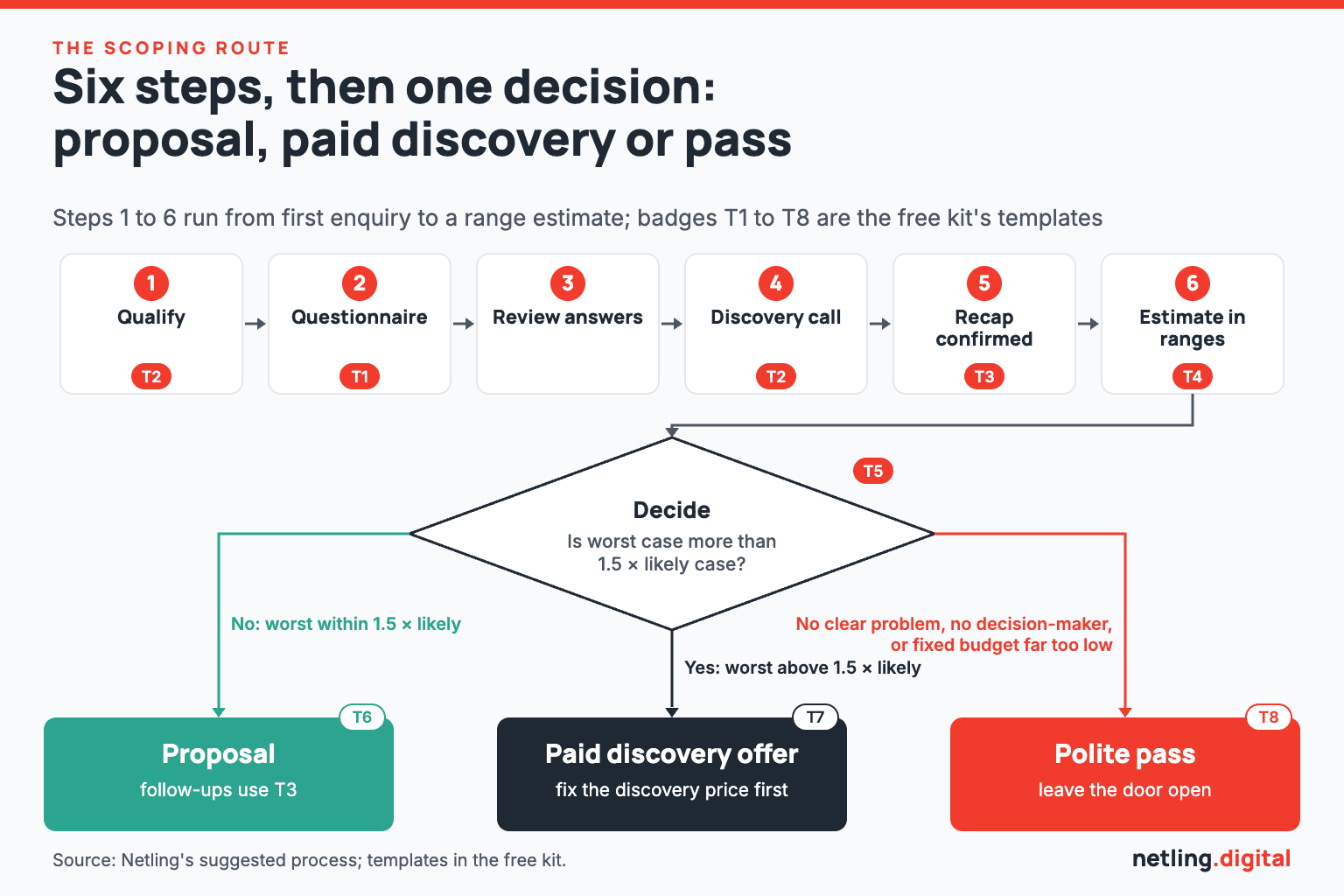
TL;DR: How to scope a software project as an agency comes down to six steps: qualify the lead, send a questionnaire, read it for gaps, run one structured call, get a written recap confirmed and estimate in ranges. Send a proposal if your worst case is within 1.5 times your likely case, propose paid discovery if not, or pass if a clear problem, realistic budget or decision-maker is missing. Most vendor guides price discovery at 5–10% of the build, over two to six weeks.
A founder sends a paragraph and three screenshots and asks what it would cost to build. The agency replies with a number, and both sides find out over the following months what the paragraph left out.
This guide is for agencies and freelancers quoting SaaS products and web apps with several user roles, subscriptions and an admin side. It covers the work between that first email and the first price.
Most of it is how we work at Netling: we send a written recap the client confirms, offer paid discovery when scope is unclear, and turn projects down with a short explanation. The eight templates are new, written for this post and not yet used with our clients, so trim them to fit your own work.
The free project scoping template kit
No email needed. Each Google link opens a "make a copy" page, so you get your own editable version; the PDF and Word files download directly.
- Client discovery questionnaire: 41 questions in 10 sections · Google Doc · PDF · Word
- Qualification script and discovery call agenda · Google Doc · PDF · Word
- Call recap email, with two follow-ups · Google Doc · PDF · Word
- Scoping sheet with best, likely and worst hours · Google Sheet · PDF (guide) · Word (guide)
- Decision table: proposal, paid discovery or pass · Google Doc · PDF · Word
- Software project proposal outline in 10 parts · Google Doc · PDF · Word
- Paid discovery offer, with deliverables and ownership wording · Google Doc · PDF · Word
- Polite project decline email, with a smaller first version to offer · Google Doc · PDF · Word

What does scoping a software project mean for an agency?
For an agency, scoping is the pre-sales work that turns a client's idea into something you can price. It ends in one of three replies: a proposal with a price, an offer of paid discovery, or a polite pass. In-house project managers use the word for a later job, the scope statement for a project that is already approved.
Replying to the first email with a price skips all of that work. The cone of uncertainty, a widely cited estimating model, puts estimates made at the initial-concept stage anywhere from 0.25 to 4 times the real effort (Construx). On a 400-hour guess, that means anything from 100 to 1,600 hours. And that is the best case: estimates at that stage can be less accurate than the cone, but not more.
Step 1: Qualify the lead before you spend hours on it
A short call or a few emails should settle four checks before you start a full scoping process:
- Fit: is this a product your team builds well? A client portal and a marketplace are very different projects.
- Budget: offer bands instead of asking for a number: under $20k, $20k–50k, $50k–100k, over $100k, or not sure yet.
- Timing: is there a real reason to start soon, or is the founder still exploring?
- Authority: are you talking to the person who signs off the budget, or to someone collecting quotes?
The bands start at $20k because 2026 vendor estimates put even a simple SaaS MVP at $20,000–50,000 (Technource) or $30,000–80,000 (Purrweb). A founder who ticks "under $20k" for a multi-role product is below both, and you learn it before the call. Adjust the bands to your market; our guide to what custom web apps cost explains the drivers.
If two of the four checks are clearly missing, say so kindly and offer to check back later. Part A of template 2 has a line for each check.
Step 2: Send a client discovery questionnaire before the call
A structured questionnaire gets the client thinking in the order you need. Four habits make it work:
- Send it before the call, not instead of it. The answers let you spend the call on the gaps instead of the basics.
- Make "not sure yet" a valid answer. Each one marks a risk you can raise on the call.
- Ask for a budget band and the reason behind the deadline. An investor demo and a signed customer contract put different limits on version 1.
- Ask for attachments: decks, sketches, spreadsheets and screenshots of the tools they use today.
Template 1 has 41 questions in 10 sections. Five of them are specific to SaaS products and web apps: users and roles, billing and subscriptions, the admin back office, integrations and data, and security and compliance. If the founder hasn't chosen between a web app and a mobile app, our post on which to build first helps.
Section 5: the admin back office questions
Copy this section first. In our projects, the admin back office is the topic that most often turns out bigger than expected, and if nobody asks about it early, it surfaces in paid discovery.
- Who on your side will manage users and accounts, and what do they need to do (create, suspend, change plan, delete)?
- Will your support team need to see what a user sees, or log in as that user to help them?
- Who can issue refunds, credits or billing overrides, and does anyone need to approve them?
- Which reports or exports do you need on day one? (sign-ups, revenue, usage, a CSV for your accountant)
- Do you need a record of who changed what, and when?
Step 3: Read the answers for gaps, contradictions and cost drivers
Read the questionnaire end to end the day before the call and mark three things:
- Gaps: blank answers and every "not sure yet".
- Contradictions: a budget band under $20k next to fifteen must-haves, or a launch in six weeks with no designs.
- Cost drivers: several user roles, billing, integrations, data migration, compliance, and anything real-time or offline.
For each integration, check whether the client has API access and documentation. Without them, API and integration work is close to impossible to estimate.
Then pick the three to five answers that most affect the price. They get most of the call.
Step 4: Run the call from a discovery call script
About an hour is usually enough if the questionnaire came back first. The discovery call script in template 2 splits the hour into six stages:
- Open (5 min): agree the agenda, and permission to ask direct questions about budget.
- Their story (5–10 min): why this product, and why now.
- Problem and users (10–15 min): what has been tested and what is still a guess.
- Scope walk-through (15–20 min): one flow, screen by screen.
- Constraints (10 min): the budget band, the date and its reason, who decides, and how much time they can give each week.
- Approach and next step (10 min): a short outline of your approach and a dated next step.
Three habits that bring hidden scope out
- Ask about the last real time. "Tell me about the last time one of your users hit this problem" gives you facts you can price, which "Would users want this?" rarely does. Our guide to requirement elicitation techniques covers more methods.
- Walk one flow in detail: sign up, invite a colleague, pay, fail halfway. Then walk it again from the admin side: "A customer emails support because they were charged twice. What does your team do, screen by screen?"
- Make them choose. "If only one of these two could make the launch date, which one?" A list where everything is a must-have isn't an MVP scope yet.
Let the client do most of the talking. Our own first call is 30 minutes, run by Dipesh, our founder. Template 2 has a 30-minute version for when the questionnaire comes back complete.
Step 5: Send a written recap and get the client to confirm it
Send the recap within a day, while the call is fresh. Ours goes out the same or next day after a first call. Template 3 covers six items:
- What they're building, and for whom, in one or two sentences
- Version 1 must-haves, and what was agreed to wait
- Budget band, target date and the reason behind the date
- Who makes the final decision, and who is the day-to-day contact
- Your assumptions, for example card payments through Stripe only in version 1
- Open questions, with who answers each one and by when
It ends with one line: "If anything here is wrong or missing, reply and we'll correct it."
A confirmed recap is the brief you price against, and a correction is an estimate error caught before it reaches a proposal. One client corrected our recap: they had assumed the admin back office was in version 1, and our recap had left it out. Without that reply, our proposal would have priced a version 1 with no admin side, the module with the widest range in the example below.

Step 6: Estimate in ranges, module by module
We recommend estimating with the person who will lead the build, so no single person's optimism sets the price. Work through it in this order:
- Modules: accounts and roles, the core workflow, billing, admin, notifications, integrations and reporting.
- The work nobody asks for: setup, environments, deployment, testing, security basics, error tracking, project management and launch.
- Ranges: a best, likely and worst case for each module.
- Unknowns: anything you can't estimate within a factor of two, such as an API you haven't used or an architecture pattern nobody has chosen yet.
- Assumptions: "the client supplies final copy by week 3", "one language at launch". They go into the proposal word for word.
- The budget check: if the likely total is far above the band the client chose, plan a smaller version 1 now.
A worked example: four modules, three ranges each
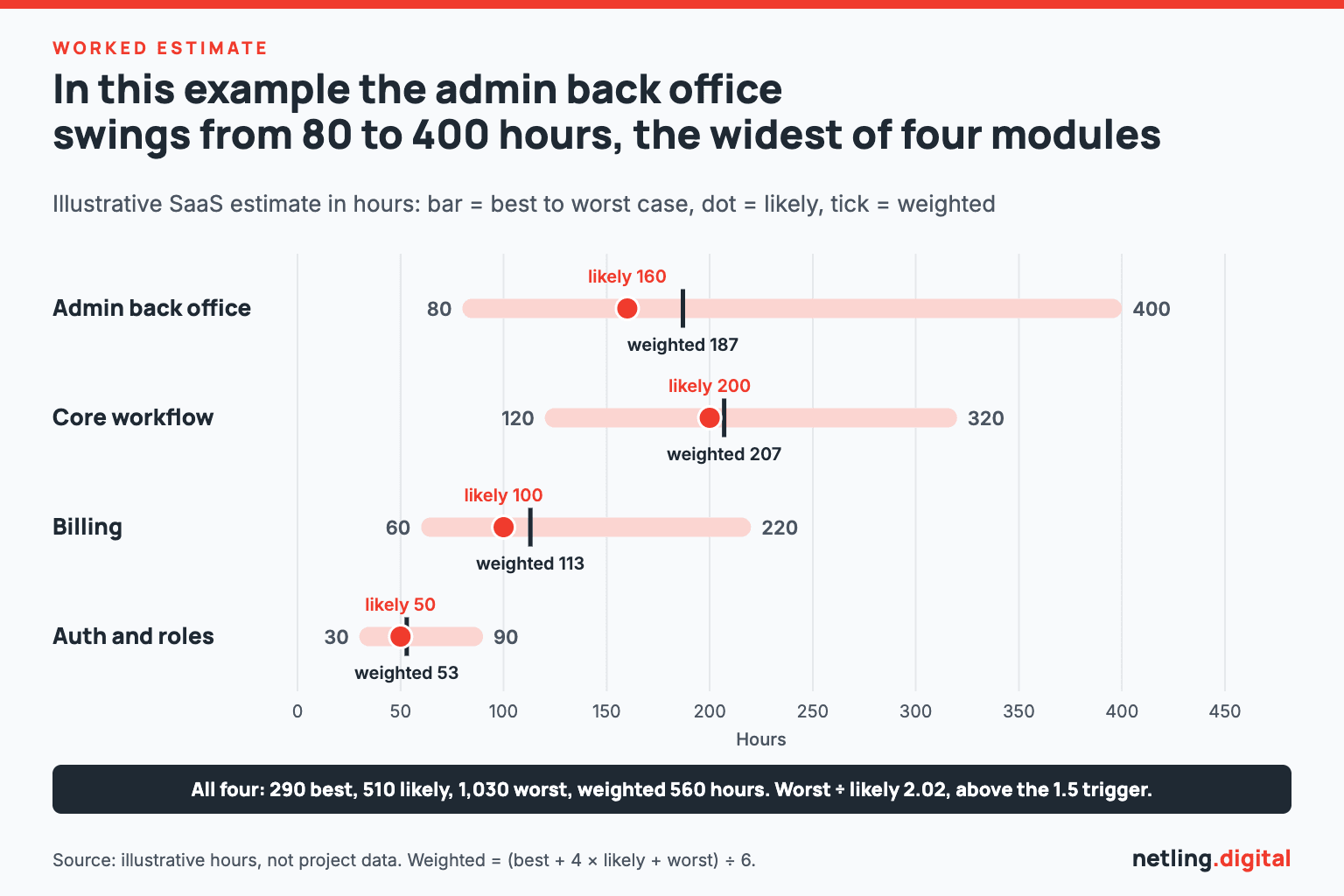
The hours are illustrative, not project data (best / likely / worst): auth and roles 30 / 50 / 90, billing 60 / 100 / 220, admin back office 80 / 160 / 400 and core workflow 120 / 200 / 320. Together that is 290 hours at best, 510 likely and 1,030 at worst. The usual three-point weighting, (best + 4 × likely + worst) ÷ 6, gives 560 hours. The width of each range shows where the risk sits: here, the admin back office.
Use the weighted figure as your planning number if you go to a fixed price. If you show the client a range, we suggest likely to worst (510–1,030 hours here) rather than best to worst, so the low end is a figure you expect to need. Template 4, the scoping sheet, comes pre-filled with this example.
The decision: send a proposal, propose paid discovery or pass
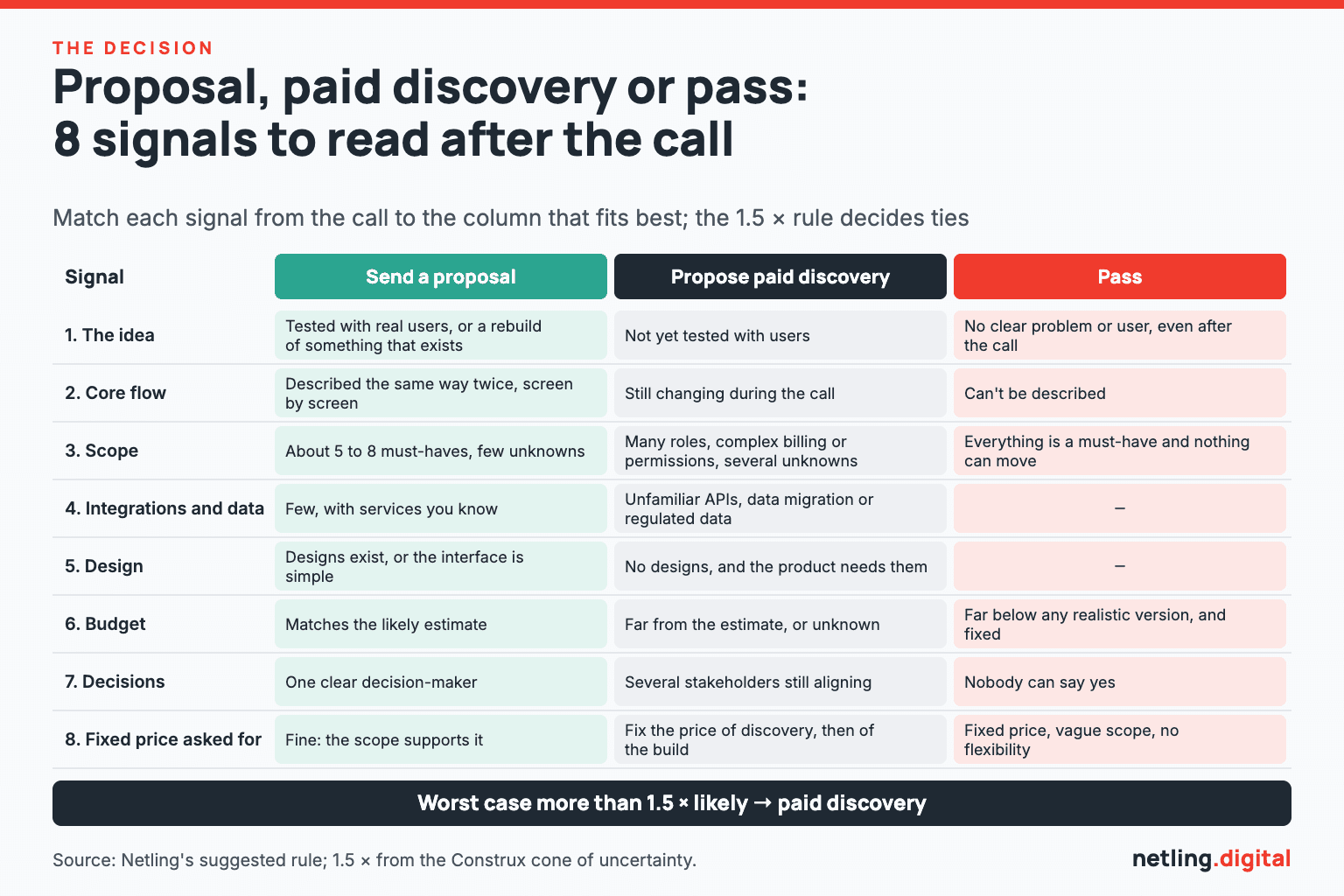
Choose by how sure you are of what you'd be pricing, not by how big the project is. Send a proposal when the brief is confirmed and your worst case is within 1.5 times your likely case. Propose paid discovery when it isn't. Pass when there is no clear problem, no decision-maker, or a fixed budget far below any realistic version.
Why the trigger is 1.5 times, at any hourly rate
Even with complete requirements, the cone of uncertainty puts the worst case at about 1.5 times the estimate. If your spread is wider than that, your requirements aren't complete yet, and completing them is the job of discovery. Treat it as a defensible line rather than a law.
The trigger also compares your risk with the fee. If discovery costs 10% of the likely build, a worst case above 1.5 times the likely case means the hours at risk (worst minus likely) are more than five times the discovery fee. Your hourly rate cancels out, so the rule works at any rate.
In the example, 1,030 ÷ 510 is 2.02. That puts 520 hours at risk against a 51-hour fee, about ten times the fee, so propose discovery. A tighter version of the same brief, with 510 likely and 695 worst, is 1.36 times: 185 hours at risk, 3.6 times the fee. That one gets a proposal.
The middle option: a fixed discovery price plus a build range
The middle reply can be one document: a fixed price for discovery and the likely-to-worst range for the build. Smashing Magazine suggests running discovery as a separate contract with a fixed price. It is also our default after a first call: the founder gets a ballpark range for the build plus a proposal for paid discovery.
What to put in a software project proposal
Template 6 has ten parts:
- Their goal, in their own words, taken from the confirmed recap.
- What you'll build in version 1, plus a not included list.
- How you'll build it: milestones, what they see at each one, and how sign-off works.
- Assumptions, copied from the scoping sheet.
- Team and timeline, including what you need from them and when.
- Price and engagement model: a fixed price, or time and materials with a range and a monthly cap.
- Changes to scope, as a clause in the proposal itself.
- After launch: warranty, support and hosting options.
- Proof: one or two similar projects and a reference.
- Next step, with the decision date you agreed.
Part 7: the change clause
Part 7 needs the most care. Say how a change is raised (in writing, by either side) and how you estimate it: hours, price and the effect on the launch date, within a set number of working days. Name who approves it on the client's side, and state that nothing outside the agreed scope starts before written approval. Approved changes move the price and the date. PMI's 2018 survey found scope creep on 52% of projects of all kinds.
Walk the client through it
Walk the decision-maker through it on a 30-minute call rather than emailing the PDF, and cover their goal and version 1 before the price. If the price is a stretch, change the scope rather than the rate. Agree a decision date; template 3's follow-up emails cover the silence after it. For the client's side, see how clients choose a development company.
How to price and sell a paid discovery phase
What paid discovery produces
Sell discovery as a small fixed-price product with a clear output: agreed requirements that planning, design and the build can follow. Template 7 lists the deliverables:
- Stakeholder interviews with the founder, their team and, where possible, a few target users
- A requirements document for each type of user, the admin side included
- User stories and user flows for the main tasks
- A prioritised feature list, split into version 1 and later
- A technical review, with each integration checked against its real API
- A risk list, with how each risk is handled
- A fixed quote and plan for version 1
Architecture, wireframes and screen design start from these requirements afterwards, so the list has no clickable prototype. Our own discovery covers Phase 01 of our approach, with the same interviews, requirements document, user stories, technical audit and risk matrix. It ends in a fixed quote and plan for version 1.
How long discovery takes and what to charge
Vendor guides commonly put discovery at two to six weeks (GroupBWT), often three to four for a SaaS build (Acquaint Softtech). On the fee, guides span roughly 5–15% of the expected build: most vendor guides say 5–10%, Fora Soft says 8–14%, and Smashing Magazine suggests about 10% as a rule of thumb. On a $40,000 build, 5–15% is $2,000–6,000, or $4,000 at 10%.
Price from your own build estimate, because vendors' dollar figures don't line up. Acquaint lists $6,000–15,000 for a SaaS platform, GroupBWT $15,000–40,000 for a mid-sized project. Then scale the deliverables to the fee. In the example, 10% of the 510 likely hours buys 51 hours, about 1.3 person-weeks. Calendar weeks run longer, because they include the client's workshops and answer time.
When the founder asks why they should pay before a quote
Answer with your own numbers rather than a sales line. Template 7 opens like this, filled in with the example above:
From our call and your questionnaire, three things would move the price of version 1 the most: [the admin back office], [the payment provider's API] and [the data in your current spreadsheet]. Today our estimate for the build is [510] hours, with a worst case of [1,030]. Discovery replaces those guesses with decisions, so the build quote is firm.
If the client goes ahead, you can credit part or all of the fee against the build within a set window. Template 7 has wording for crediting and for not crediting.
Who owns what discovery produces
Paying for discovery doesn't by itself give the client the outputs. In the US, a transfer of copyright is not valid unless it is in writing and signed (17 U.S.C. §204(a)). In the UK, the creator is the first owner of copyright in commissioned work unless the parties agree otherwise in writing (GOV.UK). Without a written assignment, the client may get only a limited licence to use the work. If you tell clients they own the requirements document, put a written assignment in the discovery agreement. This is general information rather than legal advice, so have a lawyer in your jurisdiction check the wording.
How to turn a project down without burning the bridge
Capacity alone is a different case: if the build is more than your team can take on, a white label web development partner can deliver it under your brand. When the reason is the brief itself, a good decline has four parts:
- Thanks for the time they put in.
- The honest reason, in one line.
- What would change the answer: a bigger budget, a tested idea or a decision-maker.
- One useful pointer, such as a no-code tool for a first test.
One project we passed on had a fixed budget far below any realistic version of the scope. Before passing, we suggested a much smaller first version, and the client declined. Template 8 is built around that case:
Built properly, the version you described needs more than that budget, and cutting quality to fit would leave you with something that's hard to launch and harder to grow. So we won't quote for the full scope.
When this scoping process is the wrong choice
- Small, well-defined jobs such as a landing page or a batch of bug fixes, where the questionnaire is bigger than the job.
- Repeat clients on a stack you already run: your last project is the better guide.
- Warm referrals, where a call should come before the form.
- Full discovery on a small build. A two-person, three-week discovery is about 240 hours, which at 10% needs a likely build of about 2,400 hours. Below that, cut it to the deliverables that settle your biggest unknowns, as the 51-hour example does, or phase the build.
- Briefs already inside the 1.5 times line, where discovery only delays a proposal you could send now.
If the client needs someone to make product decisions for them, an agency estimate is the wrong tool: they need a product lead first.
Frequently asked questions
How do you scope a software project?
Get the client's answers in writing before you talk, and walk one real user flow with them. Have them confirm a written summary before anyone prices it. Then estimate each module as a best, likely and worst case. The gap between likely and worst tells you whether to quote now or sell discovery first.
What questions should I ask a client before starting a web development project?
Ask what each type of user can see and do, how the product will charge, and what the client's own staff must do behind the scenes, such as refunds and support logins. The free questionnaire in Step 2 turns these into 41 questions a client can answer before the call.
What should a software project proposal include?
The client's goal in their own words, version 1 with a "not included" list, assumptions, team and timeline, price, and a clause for handling changes. The proposal outline above lists all ten parts and what the change clause should say.
How much does a discovery phase in software development cost?
Usually a small share of the build: most vendor guides say 5–10% of the expected build cost, and a few go a little higher. Work the fee out from your own build estimate rather than a published price list, because published dollar figures vary a lot between vendors.
When is a paid discovery phase not worth it?
When the job is small and well defined, or your worst case is already within about 1.5 times your likely case, a proposal gets the client building sooner than weeks of discovery. The "wrong choice" section above covers repeat clients and referrals.
How to scope a software project from your next enquiry
- Adjust the budget bands in the questionnaire to your market, then send it with your next SaaS enquiry.
- Put your next estimate into the scoping sheet and compare the worst case with the likely case before you reply.
- Add a change clause to your proposal template and a written assignment to your discovery offer.
If the scope comes back bigger than your team can take on, we build web apps and portals under your name, with an NDA first, a written quote before any work and no credits in the code. Netling has delivered 3,000+ projects since 2008, with a team of 15+ engineers, designers and PMs. See white label web development, read how agencies win bigger projects with a white-label partner, or send us a brief.
More Articles
Continue reading from our engineering blog.

Stop Saying "No" to Complex Projects: How White-Label Partners Empower Your Sales Team to Win Bigger
Stop turning away high-revenue projects. Discover how a white-label AI-native engineering partner transforms your agency's sales capacity and allows you to compete for complex technical contracts with zero hiring risk.

Best Web Design and Development Blogs to Follow: 33 Checked
33 web design and development blogs and newsletters, each with an editorial post (not sponsored or deals) in the 90 days to 18 Nov 2026, dated from its own feed or home page. Plus what became of the 21 blogs on our 2018 list.